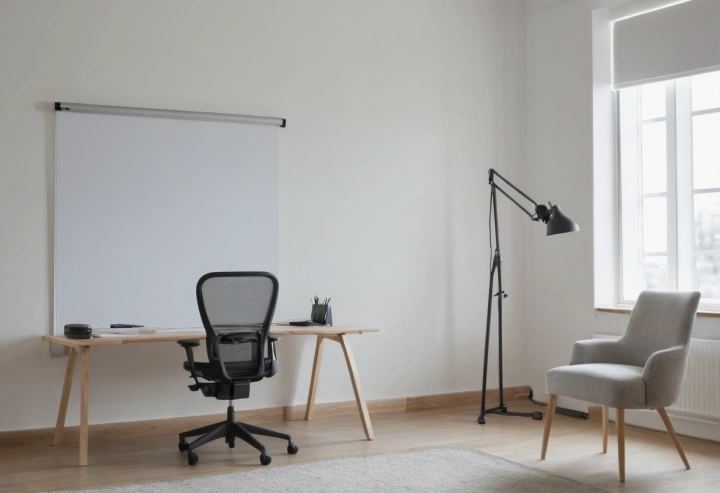
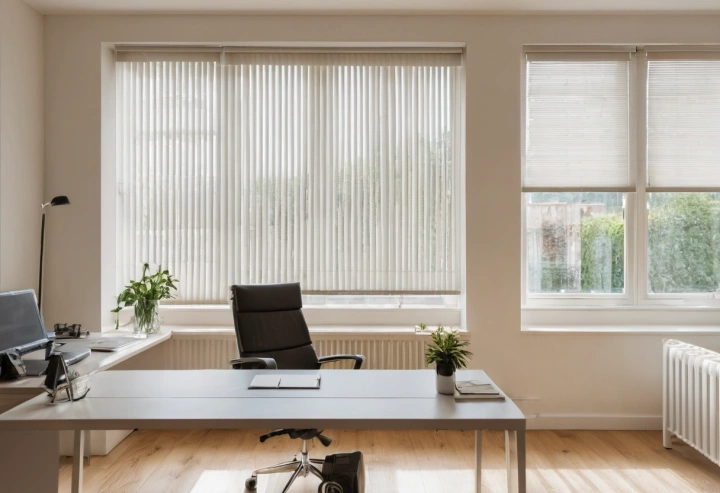
Quieting a hard-floored home office for video calls
Tiled floors and bare walls make a room look sharp and sound dreadful. Here is the order to fix it in, what each layer does, and how to keep it clean in a dusty climate.
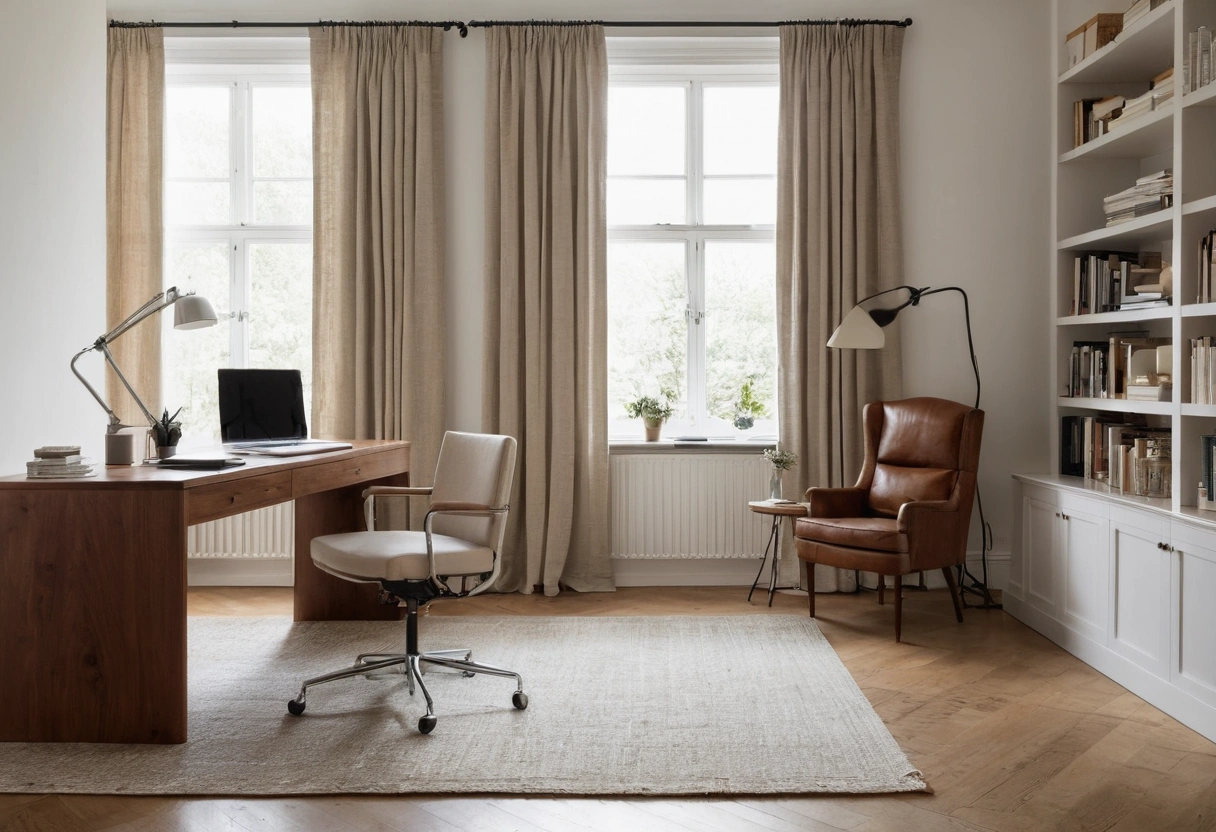
This is for anyone taking video calls in a UAE flat with tiled or stone floors, painted plaster walls and little soft furniture: the spare bedroom that became an office, or the corner of a living room that did. The complaint is always the same. You sound hollow and distant, your own voice comes back at you, and the other side asks you to repeat things. None of that needs building work. It needs soft material in the right places, a microphone nearer your mouth, and a plan for keeping the fabric clean.
Why a bare room sounds worse than it looks
Hard surfaces reflect sound rather than absorb it. In a room with a tiled floor, smooth plaster and uncurtained glass, your voice bounces between parallel surfaces several times before it fades, so the microphone hears your words plus a smeared copy arriving slightly late. Callers describe that as bathroom echo, or as sounding like you are at the far end of a table.
The air conditioning adds a steady hiss underneath everything. Most call software suppresses constant noise reasonably well, but heavy suppression also chews at consonants, which is why heavily processed audio can sound worse than a slightly noisy room.
Two separate jobs get confused here. Absorption reduces the ringing inside the room, and only soft, porous material does it. Blocking sound from passing through a wall or door is a different problem, solved by mass and airtight seals, not foam. A panel on the wall will make your voice cleaner. It will not stop the neighbour’s television reaching your microphone, and no amount of fabric will.
The order to do it in
Work from the largest bare surfaces towards the smallest, and stop when calls sound acceptable rather than when the room looks finished.
- Floor first: a rug big enough to sit under the desk and the chair, including the space the chair rolls into.
- Glass second: curtains with real fullness, hung close to the wall and long enough to reach the floor.
- One wall third: a filled bookshelf, or a run of panels at seated ear height.
- Microphone last, once the room has stopped ringing.
Doing the microphone first is tempting because it is cheap, and it does help. But a microphone in a live room simply captures the liveliness more accurately.
Rugs and curtains, and looking after them
A small rug floating in the middle of the floor is decoration. For acoustics, the useful area is the patch of floor between your desk, your chair and the wall you face, because that is where sound reflects up towards the microphone. Choose a dense pile rather than a thin flatweave, and put an underlay beneath it. The underlay does more acoustic work than most people expect, and it stops the rug creeping across polished tile whenever you push back from the desk.
Curtains earn their keep when they are heavy, gathered and close to the glass. A flat panel of thin fabric pulled tight across a window does very little. The same fabric hung in folds, standing a hand’s width off the glass and overlapping the frame at both sides, absorbs noticeably more. Lining helps. So does length: fabric that puddles slightly on the floor covers the gap where sound leaks past.
Care matters more here than in a temperate climate. Fine dust gets in even with the windows shut, and settles into pile and weave.
- Vacuum the rug weekly with a brush head, and take it outside for a shake and a sunning every few weeks.
- Rotate the rug so the chair wears one patch less, and check the underside for grit that can scratch tile.
- Wash or dry-clean curtains before they look dirty; fabric holds cooking smells from the kitchen long before visible dust.
- Keep the air conditioning filters clean, since a clogged filter rattles and pushes dust into the room.
Watch for damp on any wall behind heavy curtains if the flat stays closed up with the cooling running for long periods.
Shelves, storage and the odd useful panel
A full bookshelf is the cheapest acoustic treatment most homes already own. Books of different depths, pushed in to uneven positions, break up reflections rather than bouncing them straight back. Paper is mildly absorbent too. An empty shelf unit does the opposite, acting as a set of hard parallel planes, so fill it or leave it out of the room.
Place storage where it does double duty: on the wall behind your chair, which is also the wall the camera sees, or on the bare wall opposite your desk. Baskets, files and boxed paperwork all count as soft-ish, irregular mass. If you are still deciding what goes where, our notes on converting a spare bedroom into a client-ready home office cover layout and the door alongside the acoustics, and there is more on squeezing a workable desk into shared space in starting an online business from a corner of the living room.
Panels come after that. Purpose-made absorbers are rigid slabs of mineral wool or dense foam wrapped in fabric, and they work because they are thick and porous. Thin decorative foam tiles mostly affect high frequencies, leaving the room sounding dull rather than controlled. Position matters more than quantity: sit at your desk, have someone slide a mirror along the side wall, and wherever you can see the microphone from your seat is a first reflection point worth covering. Ear height while seated, not standing height, is the line to aim for.
In a rented flat, avoid glue. Removable adhesive strips hold light panels but damage paint on removal, so consider a freestanding screen, a tall plant in a heavy pot, or a fabric-covered board leaned against the wall on a shelf bracket. Anything hung above a desk should be fixed properly; a falling panel is a worse problem than an echo.
Microphone placement beats most purchases
Distance is the whole game. Sound arriving directly from your mouth falls off quickly with distance, while the room’s reflected sound stays roughly constant, so halving the gap between mouth and microphone improves the ratio sharply. A modest microphone a hand’s span from your lips will beat an expensive one sitting behind a laptop.
Put the microphone slightly to one side of your mouth rather than directly in front, so breath does not blast across it. Keep it off the desk surface itself, or at least off bare wood and glass, because a hard desktop reflects sound straight back into the capsule and carries every keyboard tap. A folded towel under the stand is an unglamorous fix that works. A boom arm clamped to the desk brings the microphone close without leaning in, which saves your neck over a long afternoon.
Avoid the laptop’s built-in microphones entirely if you can. They sit beside the fan and the keyboard, and they are usually several microphones combined to guess where your voice is, which produces the pumping, underwater sound callers dislike. A wired headset with a boom sits closest and is the most forgiving option in a lively room. If you are assembling the rest of the desk at the same time, the technology layer of a home office for a booking or travel business sets out how the computer, screens and peripherals fit together.
One more thing: turn off any extra noise processing while you test, then turn it back on. Otherwise you cannot hear what the room changes actually did.
Test it, then decide what is left
Record yourself reading a paragraph aloud, sitting normally, with the microphone where it will live. Play it back on headphones. Then clap once, sharply, and listen to the tail: a hard room gives a bright zing, a treated room a short thud. Move the rug in, hang the curtains, fill the shelf, and record the same paragraph again. Keep the recordings so you can compare honestly rather than rely on memory.
Your next step is small and specific: today, put the thickest soft thing you own on the floor between your chair and the desk, bring the microphone a hand’s span closer, and make one test recording. If that fixes it, stop spending. If your voice still rings, the wall behind your head is the next surface to cover, and only then consider panels. And if callers complain about noise from the rest of the flat rather than echo, save your money for a better seal on the door instead.