Working from home with children around, without losing the day
Most home offices in the UAE occupy a corner of a room the family also needs. Here is how to mark the boundary, share the table and set expectations that match a child's age.
This is for households where the office is not a separate room: a laptop on the dining table, a desk in the corner of the living room, a bedroom that becomes a workspace at nine in the morning and a bedroom again at night. The problem is not concentration in the abstract. It is a child who cannot tell whether a parent is typing an email or sitting in a meeting, homework colliding with a client call, and a table that never quite belongs to anyone. Signals, storage and honest expectations fix most of it.
A signal the whole household can read
A closed door is a poor signal in a flat. Doors are shut for air conditioning, for noise from the corridor, for a nap in the next room. Children learn quickly that a closed door means nothing in particular, so they knock, or worse, hover.
What works is something visible from the far side of the room, with only two states. A small lamp switched on means do not interrupt unless there is blood, fire or flooding. Lamp off means questions are welcome. Some households use a fabric band over the back of the chair, a coloured card propped against the screen, or a wooden block turned to show one face or another. The object matters less than the consistency. Choose something already in the room, so nobody has to hunt for it, and keep it in the same place every day.
Two rules make the signal survive contact with real life. First, the signal only ever means what it says. If a parent ignores it themselves, working through the off hours and taking calls during the on hours, children will rightly stop trusting it. Second, there must be a reliable way to interrupt for something genuine. A notepad beside the keyboard lets an older child write down a request and leave. A younger child can be taught to touch a wrist rather than speak, enough to get attention without appearing on a call.
For anyone taking calls with clients or members of the public, the signal protects more than concentration. Household noise, siblings arguing and a television in the background all travel down a phone line. Our notes on serving members of the public from home cover where the household stops and the working part of the flat begins, worth reading alongside this if calls are daily rather than occasional.
Sharing one table without a daily turf war
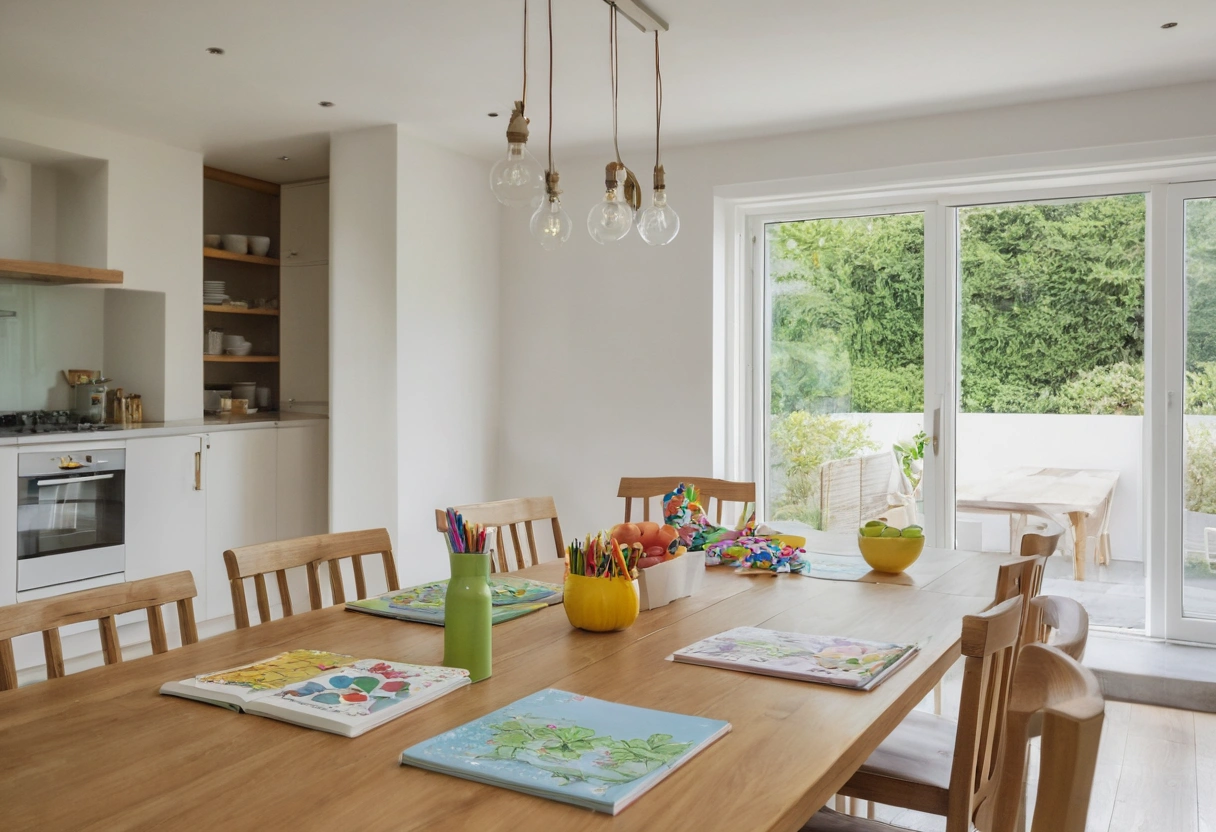
A dining table can serve homework and paid work, but not at the same moment and not in the same square metres. Divide it deliberately.
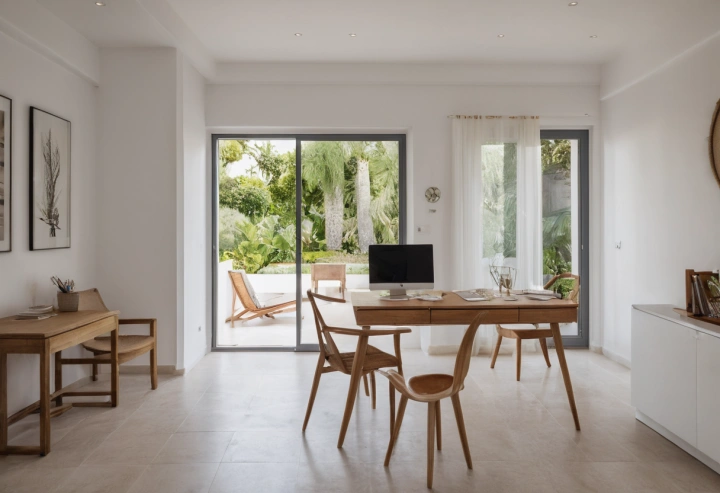
Give the working end the wall side or the window side, whichever gives a plain background and light on the face rather than behind the head. Give the children the other end, near the socket they need for a tablet and the shelf holding their books. The middle stays clear. That empty strip is the border, and it does more work than any amount of asking nicely.
Storage makes the arrangement repeatable:
- One lidded box per person, sized to hold everything they need for a session, labelled with their name or a picture for pre-readers.
- A shallow tray for the working kit: charger, notebook, headset, pen. It lifts off the table in one movement when dinner is due.
- A vertical file or magazine holder for school worksheets, standing on a shelf rather than spread flat across the surface.
- A single drawer or basket for the things that have no home yet, emptied once a week rather than left to become sediment.
The test is simple. Clearing the table for a meal should take a couple of minutes and require no decisions. If it takes longer, the problem is usually too many loose items rather than too little space. Cables want clipping to the table leg or a channel underneath, both to keep them out of reach of small hands and so the whole setup can move without unplugging everything.
Wipeable surfaces earn their keep here. Felt pens, glue and juice all find the table eventually. A mat under the children’s end, washable rather than precious, saves the argument about marks on wood.
Expectations that match the age
The commonest mistake is asking a small child for something only an older one can deliver.
Under school age
Quiet is not achievable on request. What is achievable is a short, predictable window tied to something concrete: a snack, a puzzle, a programme they watch every day at the same time. Set the work block to match that window and plan nothing important outside it. Keep a small basket of toys that appears only during working hours, so novelty does some of the work. Naps are the most valuable stretch of the day and should hold the tasks that need real thought, not laundry or admin.
Early school years
Children of this age can follow a rule but cannot yet judge urgency. Everything feels equally pressing. A visual sequence helps: pictures or simple words showing what happens before the parent is available again. A timer they can see, ideally one that shows time shrinking as a coloured disc rather than digits, turns an abstract wait into something they can watch. Praise the waiting itself, briefly and specifically, rather than only thanking them afterwards.
Homework sits best alongside working time rather than after it. Two people doing quiet focused things at opposite ends of a table is a stable arrangement. One person working while the other is told to go and play is not.
Older children and teenagers
Here the conversation shifts from rules to negotiation. Agree the fixed points of the day: which calls cannot be interrupted, which hours the table is theirs, what happens when both need it at once. Let them propose the arrangement, then hold them to it. Teenagers also need privacy of their own, and a household that expects a teenager to do homework in full view of a working parent will meet resistance that has nothing to do with laziness.
If work runs to early or late calls, the household timetable needs to account for sleep as well as noise. Our piece on working across time zones from home deals with light and rest in flats where the working day starts before the school run or ends after bedtime.
Routines that hold on ordinary days
Routines survive because they are boring and repeated. A short start-up sequence, the same each morning, tells the household that work has begun: laptop out of its box, lamp on, water bottle filled, door propped however it is normally propped. An equally short shut-down sequence tells everyone it has ended. Without the second, work leaks into the evening and children learn that a parent at the table is never really available.
Mark the transitions physically. The laptop goes into a drawer or a cupboard, not left open beside the plates. The signal goes off and stays off. In a flat with no spare room, this closing ritual is the closest thing to a commute, and it does more for the household’s mood than any amount of explaining.
Build in a slack period. School holidays, sick days and the week before assessments will break the plan. One loose afternoon in the week absorbs the overflow instead of pushing it into the evening.
Write it down, then review it
Put the household rules on one sheet of paper where everyone can see it: what the signal means, who sits where, when the table changes hands, what counts as a real interruption. For non-readers, draw it. Keep it to a handful of lines. A long document nobody reads is worse than three sentences everybody knows.
Then treat it as a draft. After a few weeks, sit down with the household and ask what actually happened rather than what was supposed to happen. Which interruptions were genuine. Which block of quiet never materialised. Whose box is always overflowing. Change one thing at a time.
The next step is small and can be done today. Choose the signal object, put it where the work happens, and explain it once to everyone in the flat, including anyone too young to read. Then pack the working kit into a single tray and give each child a box of their own. Those two moves settle most of the friction before any routine is written down.